Showing posts with label branding. Show all posts

8.15.2008

Branding in Simple Words and the Worst Movie of All Time


So I have been reading “Made to Stick” by Chip and Dan Heath. I know. I’m late to the game on this one. But they spend time talking about the importance of simplicity of ideas and how that helps them become sticky. Not sure they meant for this level of simplicity, but Phrazit is taking reviews and boiling them down to mere words.

Phrazit describes itself as “a way to browse and share condensed reviews on anything: movies, sports, restaurants . . . you name it.” Basically, users create a cloud of words and phrases around a topic. For instance, I added “Troll 2” to the cloud around “Worst movies of all time.” This is similar to Brand Tags which creates user generated tag clouds associated to popular brands.

This shows a couple of things:

  1. Brands can be boiled down to simple words. When this is done, it can be scary and exciting.
  2. A big part of brand perception is out of the hands of the branders and in control of the market. To better define your brand look for shared equity, or what you and your customers both find valuable about your company.

So what words would people associate with your brand?

6.05.2008

Got brand potency?


I had a chance to talk with Jeff Manning, the mind behind the famous "got milk?" campaign, today when he presented to the Wichita Chapter of the American Marketing Association. I was luck enough to sit by him during the event, and the branding genius left me with a few nuggets:

1) We are all brands. By extension, we are branding all the time. We cultivate our brand with every interaction, business and social.

2) Branding is evolving. "Branding" has the tendency to be a catchall phrase. There are definite things that branding is and definite things that it is not. It is not just logos and visual associations. Branding is experiential, organic, conversational and both a long-term and short-term process.

The "got milk?" work is certainly inspiring for us marketers. Beyond the humor and engaging nature of the campaign elements lie deeper issues of deprivation and simplicity that we can all learn from.

5.02.2008

Your brand in six words or less.


A new book entitled “Not Quite What I was Planning: Six Word Memoirs from Writers Famous and Obscure” is a collection of life stories, summed up in just six words. A whole life…six words. Sounds impossible, until you start to read them. For instance, “Cursed with cancer, blessed with friends” really does the job, doesn’t it?

So as marketers, can we do this? Can you tell the story of your brand in six words or less? We should be able to. Try it. Try doing it for other companies (For Starbucks: “Premium coffee at your second home.”). This sort of exercise helps us create more compelling and memorable marketing messages. And it simplifies communication with our customers.

4.11.2008

Starbucks brews a cup o' joe


You may have heard about the coffee flavor Starbucks introduced last Tuesday by giving it out for free at stores across the nation. Pike Place Roast is supposed to be for those who think that Starbucks coffee tastes too strong, bitter and/or burnt. Another name for these people: Non-Starbucks Drinkers.

Starbucks coffee has a definite taste and to fans of Dunkin Donuts swill. That taste is decidedly more extreme. I would use a terms like bold and full-bodied over bitter and burnt.

What about this new flavor? I have yet to try it, but the best description I have read so far was from James Poniewozik at Time who said, “The result, though, is a cup of coffee that tastes less like a cup of coffee.”

So is Starbucks doing the right thing? Well, I love that they introduced a product by giving it away on a certain day. It makes an event out of the launch and throws exponentially more people into the consumer process at the trial stage. Lesson here: consider giving it away for free if you can.

But, I have always thought that Starbucks was really aimed at coffee snobs (not an affectionate term, but I happen to be one, so I can use it). By attempting to brew a mass audience blend, do they abandon their core audience? Maybe. They must really be feeling the pinch from McDonalds.

Another position Starbucks strives to fill is what they call the “third place,” the other two being work and home. That is a lifestyle position. By this standard, opening up your product line to encompass more consumers could be considered a fit.

In the end, Starbucks comes off a bit desperate to me on this one. Part of the cool factor with them is that they seem to buck the system (“Screw small, medium and large! We’ll do tall, grande and Venti!”). Launching a bland roast doesn’t jive with that.

4.08.2008

A Branding Key: Understanding your strengths


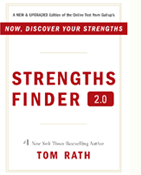
I was recently turned on to book that helps the reader define their strengths. Strengths Finder 2.0 is a book and accompanying online assessment that was developed out of a 40-year Gallup study of human strengths. The reader takes a 30 minute test and is presented with their top 5 strengths, descriptions of the strengths and an action planning guide to build on them. The test is nothing like a traditional IQ test so there is no need to study. It’s simply about preferences.

I point to this book, not because of the tremendous personal value that comes from being able to articulate and understand your strengths, but because of its relevance to branding. When branding a product or an organization, this is essentially where we start. We need to discover our company’s/product’s strengths. Not just what we say they are, but what our existing customers believe them to be. Once we know our strengths (and we would be lucky to have as many as five) we have a branding foundation. These strengths are our brand characteristics that, hopefully, set us apart. Our strengths lead directly to defining our position and creating a brand promise that the company/product will always strive to live up to.

So, are you developing your brand from a foundation of core strengths?

Oh, and in case you are wondering, my top five strengths are:

Input
Intellection
Context
Strategic
Positivity

4.01.2008

Greenwashing Activities: Not good for the environment or your brand.


Ad Age points to a new Nielsen Online study that found that misleading consumers is bad
—shocker! The study entitled “Sustainability Through the Eyes and Megaphones of the Blogosphere” finds that misrepresenting the environmental impact of your company, or greenwashing, through advertising and PR is a “fatal corporate strategy.”

Why?

Because of social media. Blogs and other social media sites are very quick to sniff out exaggerated “green” claims, sparking discussion and discontent that spreads like a wildfire (sorry for the environmentally unsound simile). For instance, Greenwashingindex.com is a site that rates the authenticity of green advertisements. Think that Dow Chemical spot touting their environmental responsibility is a bit fishy? You can check out its index rating and join in on the discussion.

This research speaks to authenticity. When we market a product, a service or a company, it is imperative that we are honest about our claims. Trying to jump on the PR bandwagon of trends like the green movement is risky business unless you can do so with transparency. Or unless you have a truly sustainable, green product.

How refreshing would it be to hear a large corporation say “I know we haven’t been very friendly to our environment, but we are trying to change. Here is how we are doing it…”

3.29.2008

UPS Whiteboard 2.0: New and improved or diminished?


The UPS Whiteboard ads have taken on a new feel, adding animation to the mix. Accompanying the spots is a new Web site that takes you on a guided tour deep into whiteboard world, complete with animated shorts that address what Brown can do for you.

The first round of Whiteboard spots were fantastic bits of ad gold. The agency world embraced them, in part, because the lead in the commercials was none other than Andy Azula, the creative director of the UPS account at The Martin Agency. Consumers responded to the offbeat presentation, the humor and the web integration.

The new ads bring back Azula and his little brown marker, but ramp up the visuals with iPod like movements and animation. So, what is happening here?

Argument one: UPS is building on a successful campaign. The animated spots still have the charm of the old spots and the whiteboard site is pretty deep. If anything, the subtle changes rejuvenate the concept and remind consumers that UPS embraces technology in the delivery of their services.

Argument two: It wasn’t broke, but they went ahead and fixed it anyway. The fact that the old spots were totally hand drawn made the campaign work. Watching Azula working his magic is what kept you tuned in time after time. It is what made you share the spots on YouTube and what spawned spoof spots. The new spots remove the magical element, and kill the spirit of the campaign.

Where do I stand? I like the old spots better, but can appreciate the move forward. What saves the new spots for me is the accompanying website. It is packed with info, addresses multiple audiences and rates high on the cool factor. From an audience perspective, as a campaign progresses, we should become more involved, more trusting of the brand and more knowledgeable about the product offerings. The added technological aspect does just that for me. We realize that it isn’t just a bunch of brown trucks, but an international tech-fueled organization that connects us to the rest of the world.

If you disagree, think of one of the alternatives. UPS could have assumed the campaign did what it was supposed to do and moved on to something else, squandering a bunch of equity.